
Robo-advisors and AI-assisted platforms reshaping retail investing
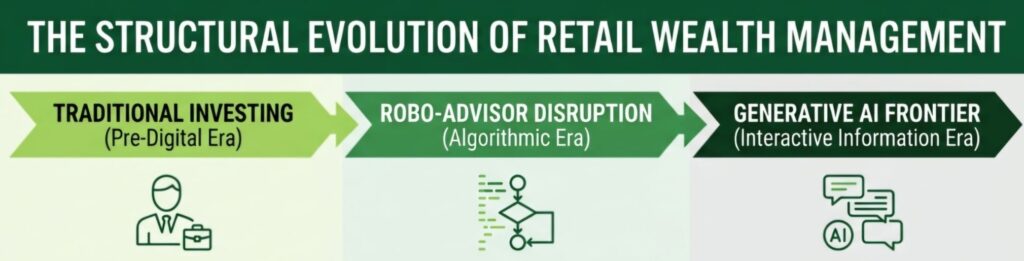
Robo-advisors introduced a more automated and accessible way of managing investment portfolios. As the timeline below shows, they sit between traditional investing and the emerging generative AI landscape, using algorithms to automate financial services and cut the need for one-to-one advice from a human advisor. That has made professional investment strategies more accessible, lowering both the fees and the minimum investments that traditional portfolio management usually requires. It still carries investment risk, though, and comes with no guarantee of better returns.
Their value goes beyond saving time and money. Automated investing can also limit some of the behavioural biases that affect human decisions. Investors may buy after prices rise or sell in panic during a downturn, while a robo-advisor follows a predefined strategy rather than reacting to market headlines. The process typically starts with a digital questionnaire covering the client’s financial goals, time horizon and risk tolerance. The algorithm then builds a portfolio, mainly using ETFs. A single ETF can provide exposure to hundreds of companies, sectors and countries, making diversification easier while keeping costs low. The focus is therefore not on picking the next winning stock, but on building a balanced portfolio for the long term.
Automatic rebalancing is another key feature of robo-advisors. As markets move, a portfolio can drift away from its target allocation and risk level. The software automatically buys and sells assets to bring it back in line, keeping risk broadly consistent over time. It cannot prevent losses or predict performance, but it adds discipline and reduces the need for investors to make these decisions themselves.
Research shows clear benefits of automated management for everyday investors, especially regarding portfolio diversification and general financial health. Adoption varies across regions; in Italy, for example, financial literacy, demographic trends and a strong reliance on banks and human advisors help explain the slower uptake of digital advisory tools. The debate, then, is about their real worth. Investors need to weigh the convenience of automation against the fees and potential performance of simple, low-cost passive strategies and self-managed investments.
The rise of Generative AI marks a new phase in digital financial advice. Unlike traditional robo-advisors, GenAI can explain financial concepts, analyse company information and answer questions through a conversational interface, making investing more interactive and personalised. It also brings new risks, from inaccurate or biased answers to investors relying too heavily on confident-sounding advice. Its rapid growth has also sparked concerns about “AI washing”, where firms exaggerate the role or sophistication of AI in their products for marketing purposes. To judge its real value, investors need to look beyond the AI label and ask what the technology actually does, how their data is used and whether the benefits justify the cost.
How AI Enters the Investment Process
AI does not play the same role at every stage of investing. In some parts of the process it acts mainly as a research assistant; in others it can operate with much more autonomy. The CFA Institute’s 2025 AI Transition Framework is a useful way to see this, since it maps AI’s role across five stages of the investment process.
1. Idea Generation
In the initial phase of the investment lifecycle, AI helps investors find and organise large amounts of market information, from earnings calls and company reports to alternative data such as web traffic or shipping activity. It can spot patterns, trends and potential signals faster than a human could, while the investor remains responsible for deciding what is worth exploring.
2. Idea Assessment
Once an idea is identified, AI helps analysts assess its potential by comparing companies, analysing historical data, testing scenarios and highlighting risks. Tools such as BlackRock’s Aladdin Co-Pilot can also quickly summarise portfolio exposures and market scenarios, making complex analysis faster and easier. The technology supports the process, but the final assessment remains with the human investor.
3. Decision Point
AI can model risk, compare possible outcomes and suggest portfolio allocations, but the final investment decision remains with the portfolio manager. Unlike an algorithm, the manager must ensure that each decision reflects the client’s objectives, risk limits and regulatory requirements. This makes human oversight essential at the point where analysis turns into action.
4. Execution
AI can take a more independent role when it comes to executing trades. Algorithms can decide when, where and how to place orders based on market conditions, liquidity and trading costs. Humans still set the rules and risk limits, but the execution itself can be largely automated.
5. Monitoring & Compliance
After a trade is made, AI can continuously monitor portfolios for changes in risk, unusual exposures or potential compliance issues. It can also turn complex performance data into clear reports for clients and regulators, while human teams remain responsible for reviewing important issues.
Three Models of Investment Democratisation
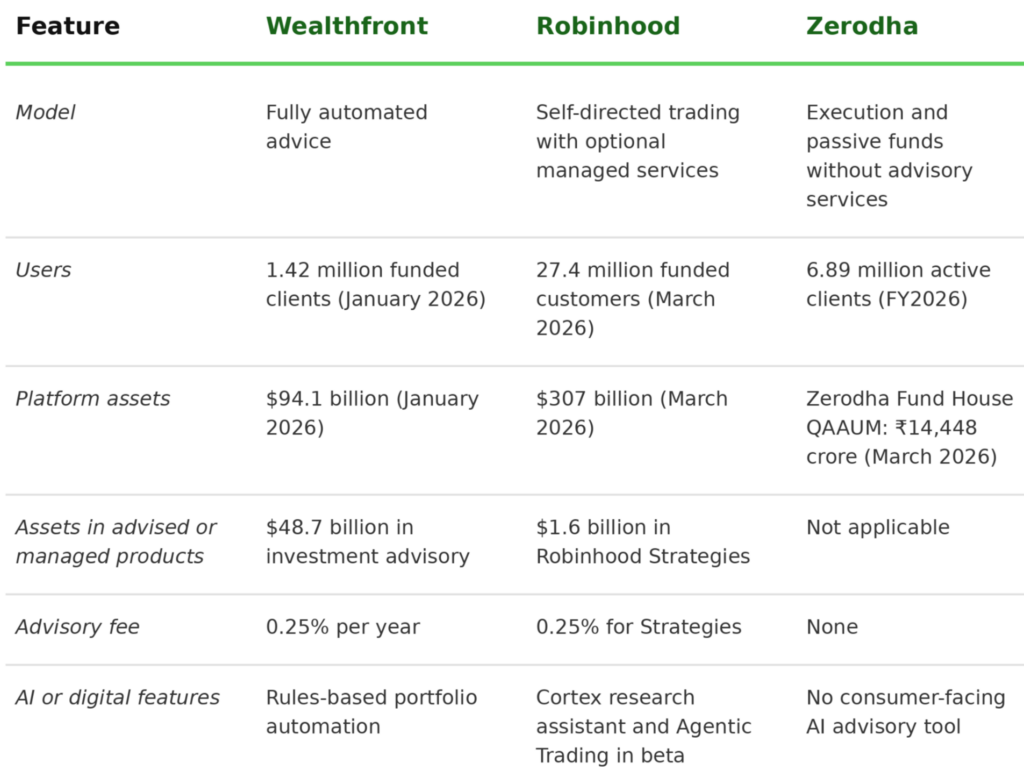
AI’s role at each of these stages also depends heavily on the kind of platform built around it, and comparing three very different investing platforms makes that clear. Wealthfront, Robinhood and Zerodha all claim to make investing more accessible, but they go about it in different ways. Automation is one route, but lower costs, simpler products, and better investor education can be just as important.
Wealthfront represents the pure robo-advisor model. Its system builds and manages portfolios automatically, based on the client’s answers about financial goals and risk tolerance, with ETFs, automatic rebalancing and limited human intervention at the centre of the service. At the same time, its business model shows that automated investing is only one part of a wider financial platform, which also includes cash management.
Robinhood follows a hybrid model. It began as a low-cost trading platform and later added managed portfolios and AI-powered research tools. Its users can remain self-directed or choose additional support, including Cortex and the beta version of Agentic Trading. This makes Robinhood a useful example of how AI can be added to an existing trading platform without becoming its main product.
Zerodha offers a different model. India’s second-largest broker by active clients does not provide investment advice. It focuses on low-cost trading, passive and direct investing through Zerodha Fund House, and free financial education through Varsity. Its approach shows that making investing more accessible does not necessarily require sophisticated AI: lower costs and better education can also help people invest on their own. Zerodha has also been openly sceptical of AI claims in finance: back in 2021, it said it had found few genuine use cases even as some competitors were marketing themselves as AI-powered, which makes it a useful contrast to the “AI washing” described earlier.
These platforms show three routes to more accessible investing: automation, digital support and low-cost self-direction. The table below compares their key features and shows that wider access depends on more than AI alone.
Human Judgment in AI-Assisted Investing
For retail investors, one of the main benefits of AI may not be the promise of higher returns, but making investing more accessible. AI-powered platforms can simplify financial research, explain complex concepts, and automate tasks such as portfolio monitoring, asset allocation, and rebalancing. This can make investing less intimidating, especially for beginners. Yet easier access to investment tools does not necessarily mean better-informed decisions. Investors still need to understand the risks behind the recommendations they receive.
A similar transformation is taking place in professional investment management. AI can process large amounts of financial information, summarise company reports and earnings calls, compare scenarios, monitor portfolios and identify patterns at a speed that would be difficult for a human to match. Rather than simply replacing portfolio managers, this could change how they work. By automating repetitive and information-intensive tasks, AI may allow professionals to spend more time interpreting results, challenging model outputs and applying their own judgement.
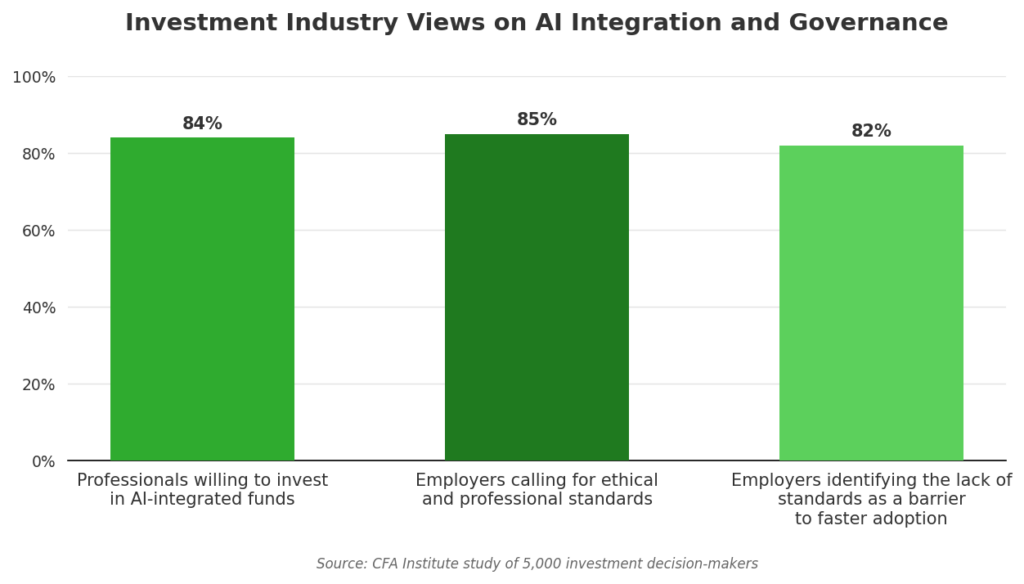
The growing interest in AI among investment professionals shows that the industry sees clear value in the technology. However, adoption is not unconditional. The CFA Institute’s research also points to the need for clearer ethical standards, stronger safeguards and appropriate human oversight. This suggests that financial professionals view AI as a useful tool, but not as a system that should operate without control.
The same trend can be seen among individual investors. According to the EY Global AI Sentiment Survey, almost half of consumers have used AI to support savings or investment decisions. This does not necessarily mean that they are ready to rely on AI for every financial decision. Instead, it shows that many people are willing to experiment with the technology and use it as a source of information or support.
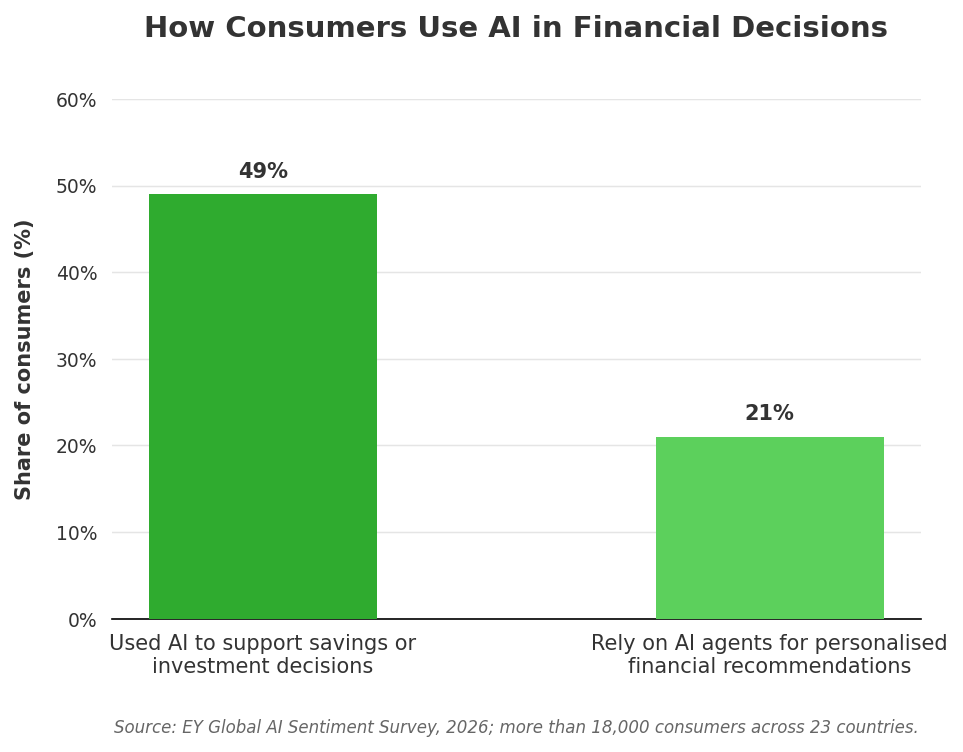
This is where the distinction between using AI as an assistant and relying on it as an adviser matters. Generative AI can produce answers that sound convincing while still being inaccurate, biased or unsuitable for a particular investor: a recommendation may appear reasonable in general but fail to reflect an individual’s financial situation, risk tolerance or long-term objectives.
Younger investors are particularly relevant to this discussion. The CFA Institute’s Next-Gen Investors report shows that Gen Z and millennial investors are comfortable using technology in their financial lives, while continuing to value human judgement and personal values. Their preference is not necessarily for technology instead of human advice, but for a combination of the two.
That combination matters because of the risk of overreliance. The more comfortable investors become with these tools, the easier it is to stop questioning what they suggest — and the more important it becomes to keep doing exactly that, rather than accepting a recommendation at face value. This is where human oversight still matters.
The same issue applies to investment professionals. In his February 2026 speech on AI and investment management, Brian Daly described a possible shift in which AI takes on more of the work involved in processing information and supporting decisions, while humans focus more on supervision and judgement. This creates a distinction between human-in-the-loop, human-on-the-loop and fully automated decision-making. As humans become less directly involved in each decision, one question becomes harder to ignore: who is accountable when an AI-supported investment decision is wrong?
The answer cannot simply be “the algorithm”. Responsibility still belongs to the people and institutions using the technology. AI can bring speed, scale and continuous analysis, while humans bring judgement, context and accountability. The best use of AI may not be to replace human decisions, but to make them better.
Written by:
- Nicolò Ballabio
- Claudia Cristofolini
- Giorgio Signorile
- Matilde Sommese