
AI -led growth faces rising energy costs, sticky inflation and higher yields
The global economy entered H2 2026 more resilient than expected. Despite geopolitical risk, supply-side disruptions coming from conflicts in the Middle East and Eastern Europe and inflationary pressures, global growth is expected to moderate during the period.
Resilience was in fact the word chosen by Citi Research’s Mid Year Outlook to best describe the behaviour of the global economy. Supply chain disruptions and increases in commodity prices, with Brent over $100 per barrel, are testing the endurance of the economy.
After Covid-19, the energy shock of 2022, tariffs and war conflicts, the global economy seems to be better prepared and more adaptable in the face of a crisis. According to JP Morgan, these repeated “one time shocks” may have made consumers more resilient, also to price increases, and have potentially redefined a new normal for households and firms. However, this does not mean that persistence in supply disruption, rising inflation and potential reassessment of the AI investment cycle won’t be sources of risk.
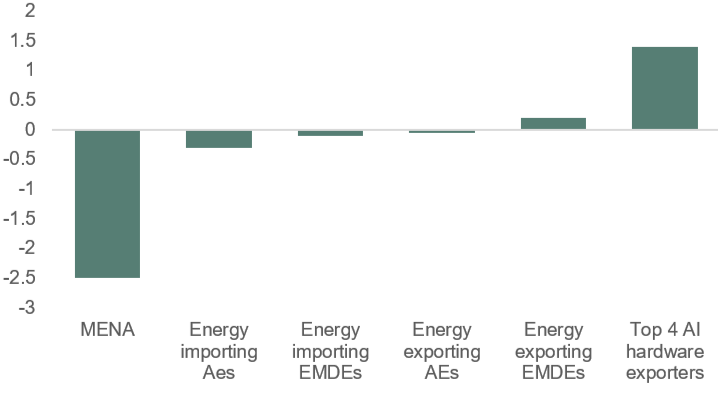
In June, the IMF updated its expectations of growth, with the indicator now projected to be 3.0% in 2026; the weakening would have been larger if it wasn’t for the positive impact of AI investment and technological momentum, driven by strong demand. This upside was strongly uneven and mainly benefited the few countries that play a key role in the technology value chain; this explains why the IMF’s revisions to growth forecasts are largely based on countries’ exposure to war and technology value chain.
The graph shows a strong positive revision of the top 4 net exporters of hardware, including Taiwan, Korea, Thailand and Malaysia, while growth in advanced economies depends on whether the country is a net energy exporter or importer. At the same time, Middle East and North Africa (MENA) growth is expected to fall from previous April projections, before recovering in 2027.
Growth revision to cumulative 2026-2027 growth forecast (%)
Source: IMF 2026 Economic Outlook
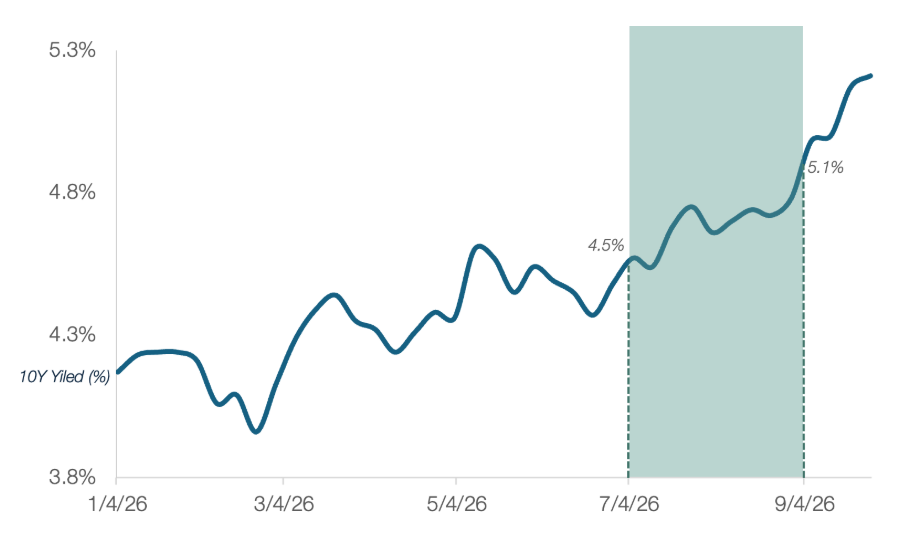
It must be considered that IMF projections were based on various assumptions, including a return to prewar state by March 2027, and the economic environment has changed from these reports. Along soaring prices of oil and gas and inflationary pressures, long term borrowing costs surged. The 10-year Treasury crossed 5%, at its highest since 2007 and bond yields have increased in major advanced economies, including US, UK, several European countries and Japan.
The key question for the coming months is whether strong corporate earnings and AI investment can sustain growth while offsetting the effects of geopolitical uncertainty and tighter macroeconomic conditions. Much of this resilience increasingly depends on one concentrated source of demand: the rapid expansion of artificial intelligence investment.
The AI Investment Cycle
The scale of the current investment cycle means that AI can no longer be treated simply as a technology story. AI is now seen as a macroeconomic driver of potential productivity and economic growth, which could support the resilience of the global economy in face of both structural and cyclical effects.
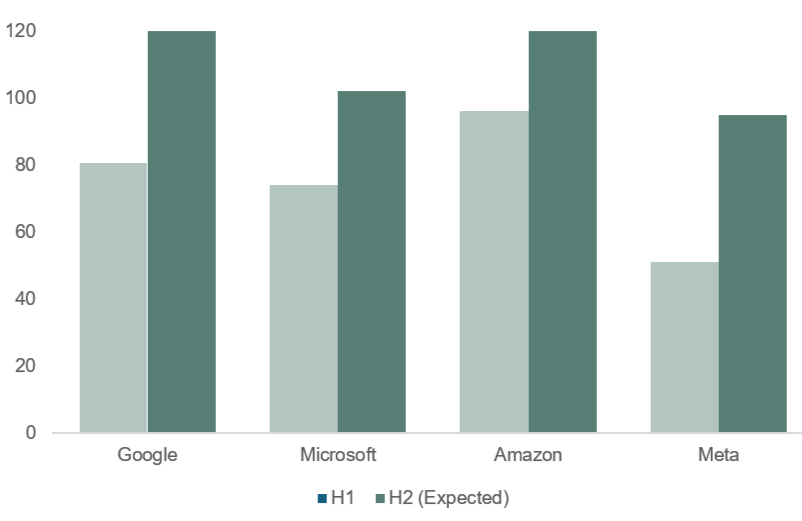
AI capex on data centres, semiconductors, power generation and cooling infrastructure appear to be keeping spending and demand high, but with cumulative AI-related investments expected to reach $5.5trillion by 2030. The sustainability of hyperscalers’ business models is central to the outlook.
Capex in H1 2026 vs projected spending in H2 2026, $bn
Source: FT
As AI becomes more capital-intensive, debt issuance becomes critical to funding AI cycles, with investment grade bonds expected to be the largest source of external capital for hyperscalers. JP Morgan estimates that hyperscalers could issue up to USD 300 bn in investment grade bonds over the next year, leading to discussions about AI hyperscalers “crowding out” capital, competing with government bonds and potentially causing upward pressure on yields.
Also Fed President, Kevin Warsh, included competition for capital as one of the reasons for surging yields.
The AI value chain is not only based on semiconductors, chips and hardware. As reported by Amundi research, the focus is shifting towards the mid and downstream of the value chain, in deployment and end-user applications to expand AI adoption. In fact, the competition may not only depend on who produces the best model in terms of performance and price, but also on who will be able to transform AI capabilities into widespread applications.
Therefore, the AI investment cycle may continue to support economic growth and expansion, while at the same time putting deflationary pressure through productivity gains. However, the constraints on AI extend beyond the actual realization of these expectations and include physical bottlenecks like energy supply, infrastructure and access to strategic materials. In addition, the sustainability of the AI race may also be affected by recent warnings from AI industry leaders, including Anthropic, about the potential risks of recursive self-improvement calling for regulatory limits intended to slow AI development. However, AI’s boom is happening in a more challenging macroeconomic situation. Its increasing requirements in terms of electricity consumption, infrastructure needs, and external financing make the sustainability of this boom more and more sensitive to the energy prices and borrowing costs.
Energy Is Back at the Centre of the Global Outlook
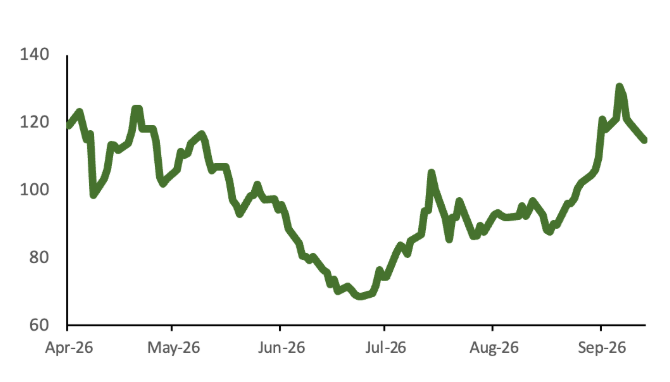
J.P. Morgan framed the second half of the year as a balancing act between an ongoing energy supply shock and an economy that has been showing signs of consistent growth. In the recent weeks however, markets have observed renewed increase in energy prices, with direct links to ongoing conflicts and geopolitical concerns. Geopolitical fragmentation persists as a structural source of uncertainty for macro and markets. Brent crude has been back at around $100 a barrel in late September. Amid geopolitical tension, political discussions and supply concerns, energy and fuel costs are also back at the center of the macro outlook. We could argue that global economic activity and outlook is being shaped by two major forces, the negative supply shock created by the war in the Middle East, and a positive technology shock.
Growth Inflation Trade-Off
Energy remains the most important inflation challenge in the short term. As of September 2026, expectations for headline inflation reached 3.5 %, nearly a full percentage point above
Brent Crude Oil Price, Apr 2026 – Sep 2026 ($ per barrel)
Source: International Monetary Fund via FRED, Federal Reserve Bank of St. Louis
compared to the start of the year, according to Citi. Core inflation has also moved higher, reflecting higher transportation costs and supply-chain pressures linked to energy markets and critical industrial inputs such as petrochemicals and fertilizers.
Higher energy prices that result from energy shocks can indeed slow growth while simultaneously raising inflation. Central banks have generally responded by tightening policy or delaying cuts, choosing to focus on inflation over supporting economic activity. As a result, long-term government bond yields have reached multi-year highs, reflecting growing doubts about fiscal sustainability. Higher financing costs strain public budgets and discourage both public and private investment.
An Endurance Test for the Global Economy
The global economy has so far handled the energy shock better than expected, although the impact has been uneven. It is determined by the nature of a country as an importer or exporter of energy and its place in the technology value chain. Strategic releases of energy from storage and the expectation of future negotiations between the United States and Iran have also mitigated the initial impact of the crisis.
Resilience should not be interpreted as immunity. An ongoing supply problem will add to inflation and slow down growth, especially for countries that are net energy importers. However, firms have become more flexible; the advanced world is less dependent on oil than in past decades, and increased energy efficiency has mitigated the impact of oil price fluctuations on growth. This will be put to the test during the latter part of the year. The energy shock therefore extends well beyond commodity markets. By raising inflation expectations and complicating the trade-off between price stability and growth, it is also reshaping the outlook for monetary policy and interest rates.
Inflation and Rates
The Iran conflict has both slowed global economic growth and raised the risk of inflation. Europe continues to take the brunt of the damage, with composite PMI readings falling below the 50 contraction mark in both the UK and the eurozone in May.
Despite this situation, Asian economies have weathered the disruption through divergent strategies: both China and Japan have buried energy supply shocks by drawing into deep stockpiles of oil inventories, while the Indian economy remains relatively unaffected. In the near term, a diplomatic agreement between the U.S and Iran would provide significant relief to Europe by supporting real economic growth while simultaneously curbing energy-driven inflation. Meanwhile, the global rush toward artificial intelligence has buoyed technology sectors across Taiwan, Korea, and China, while increased European defense spending offers much-needed fiscal stimulus.
From a monetary perspective, central banks outside the United States remain noticeably more hawkish than the Federal Reserve. With both the Bank of Japan and the European Central Bank poised to hike rates in the coming months, the yield gap between U.S and international sovereign bonds is projected to narrow. This dynamic should remove support from the greenback, paving the way for a resumption of the broader dollar decline that had paused in early 2026 amidst geopolitical flare-ups.
In fixed income markets, debt instruments have aggressively repriced persistent inflation risks. Front-end bond yields remain near their annual highs after rate-cut expectations were sharply dialed back from three cuts to just one, with markets even weighing the prospect of a second pause or hike. While two-year yields offer an attractive income buffer above cash rates, the longer end of the yield curve faces steepening pressures driven by persistent deficits and anticipated fiscal expansion ahead of midterm elections.
The ongoing conflict involving Iran and the closure of the Strait of Hormuz have dismantled the traditional central-bank playbook. For decades, policymakers adhered to the “look-through” doctrine, treating supply shocks as transitory and avoiding rate hikes to protect growth, much like Alan Greenspan during the 1990 Gulf War or Ben Bernanke in 2011.
Today, that approach is no longer tenable. With WTI crude near $100 a barrel and diesel above $6 a gallon, energy pressures risk embedding into consumer and business psychology. Coming after post-pandemic bottlenecks, geopolitical tensions, and tariffs, inflation has lingered above target for over five years, making the risk of unanchored expectations far more dangerous than the pain of higher borrowing costs.
This dynamic has globally synchronised shift towards monetary tightening. Following recent action by the ECB, swap markets are pricing imminent rate hikes by the Federal Reserve and the Bank of Japan, alongside follow-up moves by the Bank of England, Bank of Canada, and Reserve Bank of Australia.
Yet the policy dilemma remains heavily asymmetrical. While energy-producing economies like the US can absorb higher rates with less friction, the Eurozone and the UK, as heavy energy importers, face severe economic headwinds, forced to accept weaker output to prevent an imported shock from turning into chronic domestic inflation.
While central bank policy directly anchors short-term rates, capital market yields on long-term government bonds do not move in lockstep. Instead, maturities like the 10-year Bund or Treasury reflect broader inflation expectations, growth prospects, and supply dynamics shaped by Quantitative Tightening. Because sovereign benchmarks form the pricing baseline for mortgages, business loans, and corporate debt, rising long-term yields autonomously tighten financial conditions across the economy, even in the absence of explicit key rate hikes. Crucially, this transmission mechanism affects every asset class: elevated sovereign yields raise the discount rate applied to projected cash flows, exerting valuation pressure on expensive growth equities, while simultaneously restoring the relative competitiveness of fixed-income assets and driving up broader financing costs across corporations and governments alike.
The transition away from the post-2008 zero-interest-rate regime marks a structural shift for capital markets. For over a decade, ultra-cheap liquidity inflated equity multiples, encouraged private market leverage, and subsidized expanding sovereign deficits. Today, benchmark yields have mean-reverted toward historic norms (exemplified by the 10-year U.S. Treasury consolidating near 5%).
U.S. 10-Year Treasury Yield, January 2025–September 2026
Source: Federal Reserve
In this restored reality, capital carries a genuine cost. Companies can no longer rely on subsidized financing and must instead prove that prospective returns clear a demanding hurdle rate, elevating operational profitability, cash generation, and balance-sheet discipline over speculative growth. Concurrently, persistent sovereign debt supply guarantees sustained upward pressure on term premia, cementing higher baseline financing costs while permanently reinstating fixed income as a competitive component of asset allocation
Entering the latter half of 2026, the global economy is in much better shape than was anticipated earlier. Sources of strength are robust corporate earnings, flexible labor markets and sustained investment in artificial intelligence. However, this resilience will face tests from an increased mix of geopolitical tensions, energy worries and elevated interest rates.
There is still much at stake in terms of a delicate balance. While investments in AI could help sustain productivity and demand, its increasing dependence on capital and energy could leave it more vulnerable to higher yields and supply constraints Additionally, central banks need to fight inflation without putting too much pressure on already fragile energy importers.
The optimistic story has not ended but it is more nuanced now. Profits and investment discipline, combined with good policymaking, are required to compensate for higher energy prices and rising cost of capital. The global economy has shown a lot of resilience so far; the rest of the year will reveal how resilient it really is.
Written by:
- Maria Chasovnikova
- Demet Coskun
- Claudio Di Nubila
- Gloria Piantelli
- Viola Castoldi