
Why The Iran war was a failed stressed test for the world’s reserve currency
The US dollar has anchored the global financial system for decades, serving as the world’s primary reserve currency and dominating both foreign-exchange trading and international trade. Yet, the gradual erosion of its share of global reserves, mounting doubts about the sustainability of US government debt, and the unpredictability of the Trump administration have sharpened a long-running question: is dollar dominance fading? Central to that debate is whether the dollar remains a “safe haven”, meaning the currency investors and governments rush toward when geopolitical or financial stress strikes. The war in Iran, which began in late February, put that status to the test.
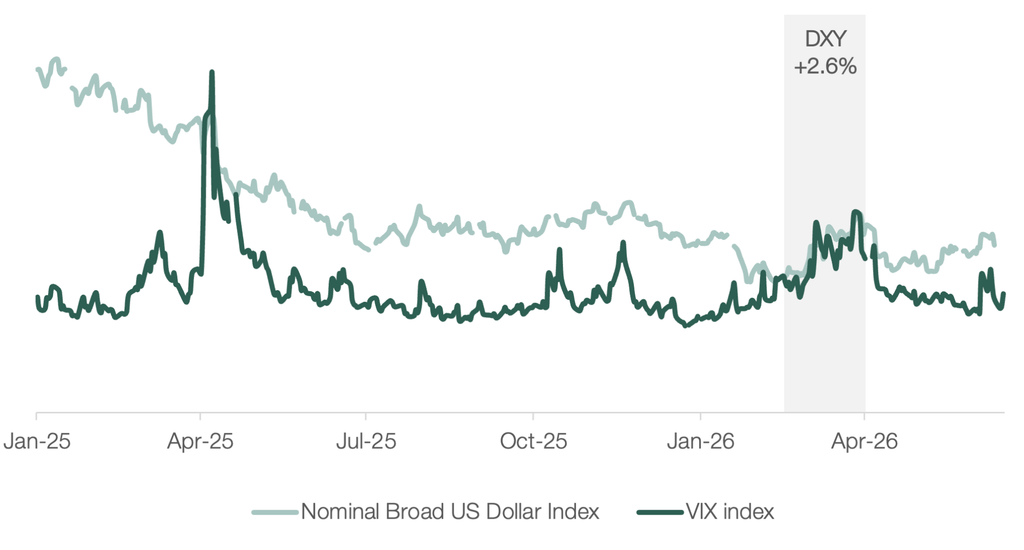
The safe-haven mechanism is straightforward. In periods of stress, investors sell risky assets and move into dollar-denominated ones, above all US Treasuries, pushing the currency higher. The relationship is often traced through the VIX, a gauge of market volatility: historically, when the VIX spikes, the dollar appreciates. The pattern held during the 2008 financial crisis and again in March 2020, at the onset of the pandemic, when the DXY index, which measures the dollar against a basket of major currencies, rose 8% in ten days.
The war in Iran produced a similar but far weaker response. The conflict pushed the DXY up by roughly 2.6% by April 2026, a smaller move than in previous crises, and the gains faded as tensions eased. JP Morgan described the episode as a “de-escalation trade”, meaning a short-term reaction rather than a durable flight to safety. The dollar has since recovered, largely on expectations of a Federal Reserve rate increase
US Dollar Index and Market Volatility (VIX), Jan 2025-May 2026
Source: FRED
However, some see a deeper shift. The Official Monetary and Financial Institutions Forum has judged that the dollar has lost “part of its specialness” as a reliable haven when market fear rises. Allianz Research reaches a related conclusion: the dollar now tends to hold its crisis gains only when dollar liquidity is scarce, suggesting its resilience reflects its role in global trade and finance more than investor confidence. That leaves the central question unresolved: is the change structural, or merely a cyclical correction?
ING takes the cyclical view, arguing that the 2026 decline lacks the hallmarks of a structural break: a genuine structural retreat would require serious doubts about Fed independence and US fiscal sustainability, and a large-scale sell-off of US assets that has not materialised. Even so, erratic policymaking has weighed on the currency, which has fallen roughly 14% from its September 2022 peak. The war, in short, offered no verdict: the dollar remained the world’s dominant currency, but it rallied less than history would predict.
The Bear Case
The Iran war did not trigger a dollar crisis. It did something arguably more telling: it failed to trigger a dollar rally.
In previous bouts of acute geopolitical stress, the response was reflexive: capital fled into US assets, yields fell, and the currency strengthened. This time the reflex did not fire. Fund managers took their most bearish stance on the dollar in more than a decade, with bets against the currency outweighing positive positions throughout the year. That was not noise but a structural reassessment by the very institutions, e.g. pension funds, insurers, asset managers, whose allocations underpin global dollar demand.
The repricing had been building well before the first shots. Unpredictable tariff action and fiscal concerns had already weakened trust in the dollar’s haven role. Trump’s pressure on the Federal Reserve, sweeping tariff threats against allies, and his public praise of dollar weakness as “great” had introduced what markets began to price as a Trump risk premium, meaning a structural discount on US institutional credibility that the crisis did nothing to erase.
Julius Baer identifies three forces likely to sustain medium-term weakness. The twin deficit leaves the dollar dependent on foreign investment to offset outflows. The One Big Beautiful Bill Act has cemented high budget deficits and an unsustainable debt trajectory. Moreover, the persistent risk of erratic policymaking continues to raise doubts about the independence of US monetary policy. Each force predated the Iran conflict; the war merely made them harder to ignore.
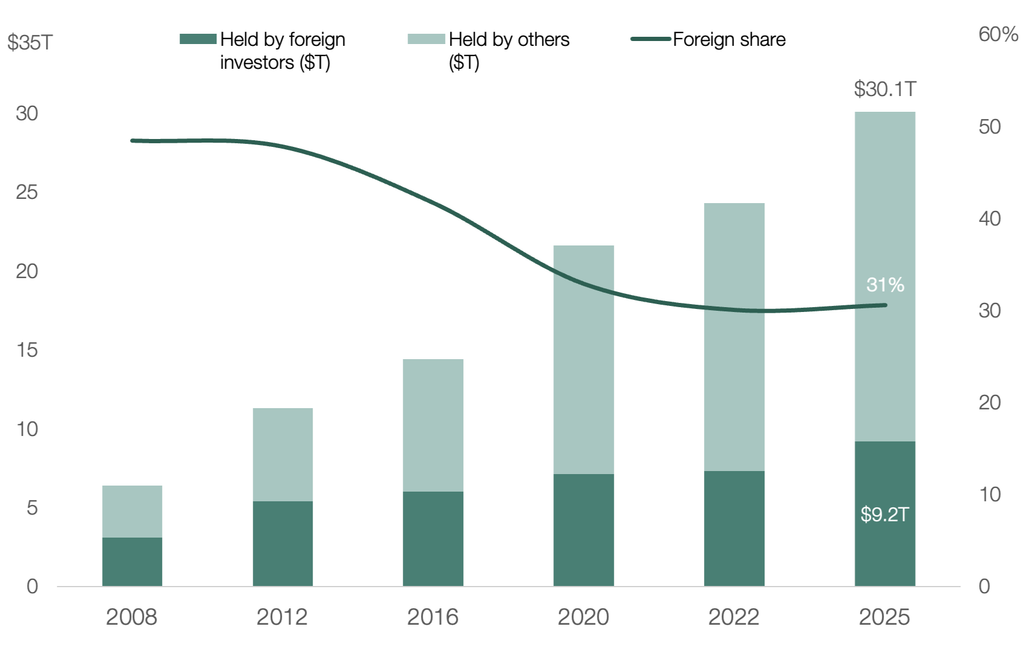
In particular, the fiscal dimension deserves attention. Foreign accounts hold more than $9.5 trillion in US Treasury securities, meaning roughly 30% of publicly held federal debt, down from almost 50% in the early 2010s. The trend is structural: debt held by the public has more than quadrupled since 2008, from $6.4 trillion to $31.4 trillion as of April 2026, while foreign holdings have grown only from $3.1 trillion to $9.5 trillion. Foreign demand is not limitless. When the US issues more debt than markets will absorb at prevailing prices, it must offer higher yields, and, because Treasury yields anchor credit pricing across the economy, those higher yields ultimately mean costlier mortgages, auto loans, and borrowing for ordinary Americans.
US Treasury debt by holder ($T), and the foreign share (%), 2008-2025
Source: FRED
The conflict also revived a longer-range question. According to Deutsche Bank, the economic fallout from the war may mark the beginning of the end of the petrodollar’s dominance. The mechanism is specific: since 1974, the United States and Saudi Arabia have priced oil exports in dollars and recycled surplus revenues into US Treasuries in exchange for security guarantees. Attacks on US bases, oil fields, and Gulf infrastructure have tested that bargain, potentially prompting some Gulf economies to reconsider their dollar reserves. Deutsche Bank cited reports of Iran negotiating yuan-denominated oil shipments through the Strait of Hormuz, speculative but directionally significant. A world more self-sufficient in defence and energy will also be one holding fewer dollar reserves.
The bear case, then, is not one of sudden collapse but of quiet erosion: shifting positioning, declining foreign Treasury demand, and a petrodollar architecture whose geopolitical foundations are being tested as they have not been since 1974.
“There Is No Alternative”
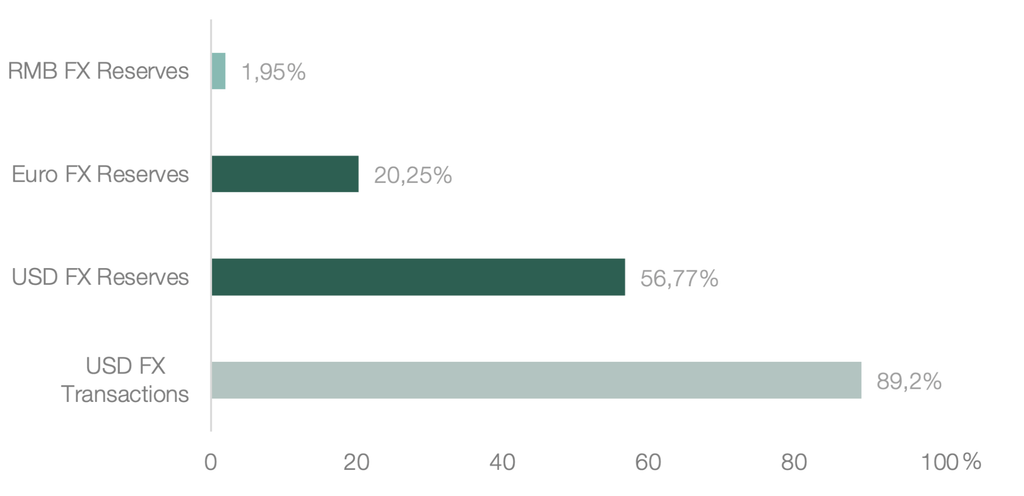
For all the anxiety over erratic US policymaking, predictions of the dollar’s imminent decline understate how deeply the currency is embedded in the plumbing of global finance. The clearest illustration is the foreign-exchange swap market: with more than $100 trillion in contracts outstanding, around 90% involve the dollar. Dismantling a network of that scale and replacing it with another currency would be enormously costly and operationally complex, being the reason enough to make any transition away from the dollar extraordinarily difficult.
Nor is there much sign of structural retreat. The dollar has shown no structural deterioration since 2024 and even saw a degree of re-dollarisation in 2025, reflected in record foreign holdings of US assets that year, a large share of it directed into US equities.
Potential challengers remain constrained by structural limitations. The euro still lacks the institutional foundations of a full fiscal union, including a common safe asset backed by jointly issued debt, while the yuan‘s international role continues to be limited by China’s capital controls and relatively closed financial system. As many economists note, establishing a credible reserve currency is a process that unfolds over decades rather than years, and the network effects that underpin the dollar’s dominance continue to encourage governments, businesses, and financial institutions to rely on it.
Sanctions illustrate this dynamic rather than undermine it. Because participation in the dollar-based financial system remains essential for most international banks and corporations, access to the dollar is often a practical necessity. As a result, even the use of financial sanctions has not fundamentally weakened the dollar’s central position in the global monetary system. For the foreseeable future, no other currency appears capable of matching its international role.
What the Data Show
Despite the recurring narrative of a collapsing dollar, the empirical evidence points to continuity rather than rupture. Reserve allocations, payment flows and institutional behaviour suggest gradual diversification, but not a decisive shift away from the dollar. According to the IMF’s latest COFER data, the dollar accounted for 56.77% of allocated global foreign exchange reserves in the fourth quarter, virtually unchanged from 56.93% in the previous quarter, while the yuan represented just 1.95%.
US Dollar Share in Global Reserves and Foreign Exchange Markets, Dec 2025 (%)
Source: IMF COFER Q4 2025
Headline reserve shares also warrant caution. As ING notes, quarterly moves are often driven by valuation effects rather than active reallocation: when exchange rates shift, the dollar’s share can fall mechanically even when central banks change nothing. Reserve data alone can therefore overstate de-dollarisation.
Behaviour reinforces the point. China has cut its Treasury holdings sharply, with sales rising from roughly $36 billion to about $145 billion over the past year. But the trend is far from universal: European investors, now being the single largest foreign owners of US equities, have kept accumulating dollar assets, offsetting part of China’s retreat. Rather than a coordinated exit, global flows look increasingly fragmented across regions.
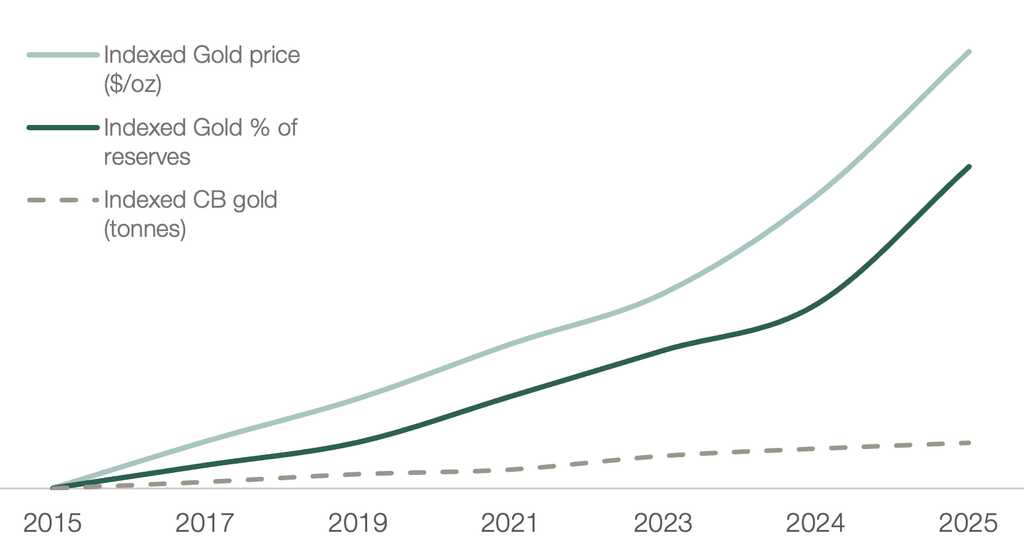
Some developments nevertheless merit attention. The yuan’‘s share of SWIFT trade-finance transactions has risen to 8.3%, while central banks have continued to increase their gold holdings as a hedge against geopolitical and financial risk. However, the growing share of gold in global reserve portfolios has been driven not only by official purchases but also by the sharp appreciation in gold prices. Since 2015, official gold holdings have increased only gradually, whereas the value of those holdings has risen much more rapidly. This suggests that reserve diversification has been incremental rather than transformational. Alternative reserve assets are gaining importance alongside the dollar, but they have yet to displace it as the cornerstone of the international monetary system.
Gold Price, Official Gold Reserves, and Gold’s Share of Global Foreign Exchange Reserves (index, 2015 = 100), 2015-2025:
Source: Fed. WGS. Brookings
That distinction is central to what some economists call the “currency doom loop.” Dissatisfaction with dollar dominance has risen, but replacing it with a multipolar reserve system could prove more destabilising still. Without a single anchor currency able to supply global liquidity in stress, and without an institution comparable to the Federal Reserve to act as international lender of last resort, the system could become more fragile, not less. Recent signals like speculation over the next Fed Chair, the Supreme Court’s 20 February ruling on presidential tariff authority, and the euro’s roughly 13% year-on-year appreciation show how politics and exchange-rate dynamics increasingly shape perceptions of the dollar’s trajectory. For now, though, reports of its decline remain exaggerated.
Less Dominant, Not Dethroned
The debate has shifted from short-term exchange-rate moves to the durability of the dollar’s global role. The evidence points to a nuanced conclusion: the dollar’s position is no longer unquestioned, but its foundations remain largely intact. The most likely path is neither sudden displacement nor imminent dethronement, but a gradual, managed erosion of relative dominance: bearish positioning, marginal reserve diversification, and fiscal and political concerns all weighing on sentiment, with several institutions expecting further modest weakness against the euro and sterling.
A weaker dollar, however, should not be mistaken for a weaker dollar system. Exchange-rate performance and reserve-currency status are related but distinct. Currency leadership rests not only on valuation but on the depth of financial markets, institutional credibility, legal certainty, and the capacity to supply liquidity in a crisis. These are dimensions on which the United States still leads, and on which no rival yet competes at comparable scale.
The gravest risk, then, is not external but domestic. Confidence in the dollar rests heavily on the independence of the Federal Reserve, whose credibility has long reassured investors in times of stress. Political interference, meaning pressure for “inappropriate” rate cuts, or the subordination of monetary policy to political ends, would do far more damage than any gradual reserve diversification. This is the line between cyclical weakness and structural decline. Cyclical pressures are plainly at work; structural decline would require a sustained erosion of institutional trust alongside a viable alternative able to absorb global reserve demand, which is a condition that remains remote.
For investors, the implications are less dramatic than the headlines suggest. A modestly weaker dollar may justify greater international diversification, but diversification is not abandonment: foreign demand for US assets remains substantial, and Treasuries remain the benchmark safe asset in stress. Ultimately, the dollar’s future may depend less on its own strengths than on the limitations of its rivals. The war in the Middle East showed that the currency no longer commands the unquestioned safe-haven premium it once enjoyed, but the same episode exposed the absence of a plausible successor. In a world searching for alternatives, the dollar remains what it has become by default: no longer the unquestioned first choice, but the least imperfect option available.
Written by:
- Maria Chasovnikova
- Demet Coskun
- Viola Castoldi
- Davide Marsetti
- Andrea Rusconi
- Niccolò Zucchini
- Viola Bidasio