
From the Digital Euro to the Compulsory Rouble
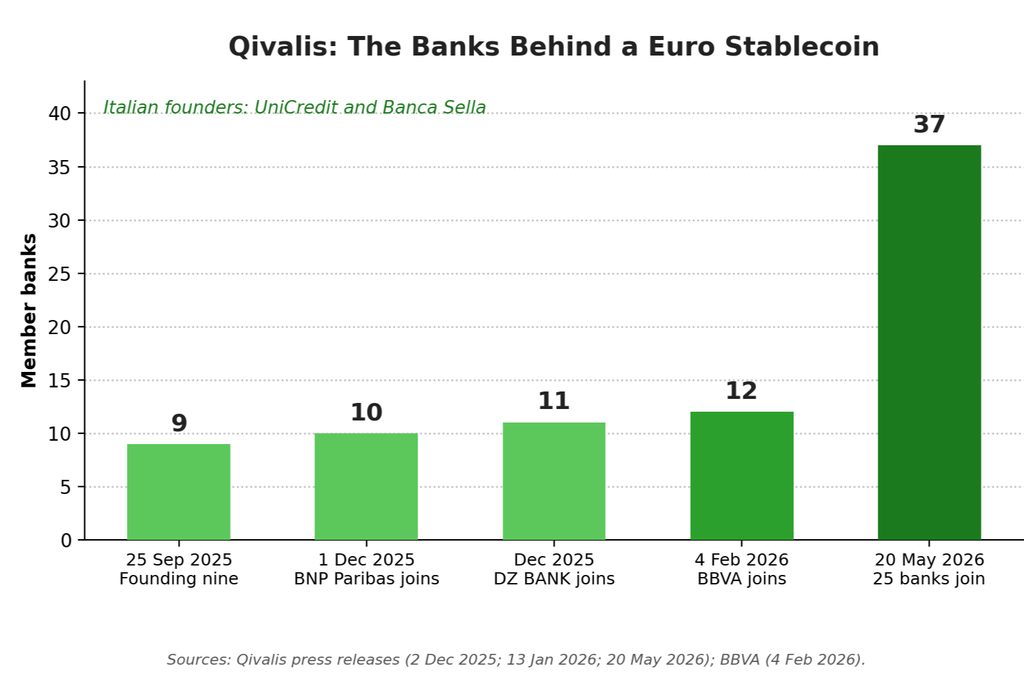
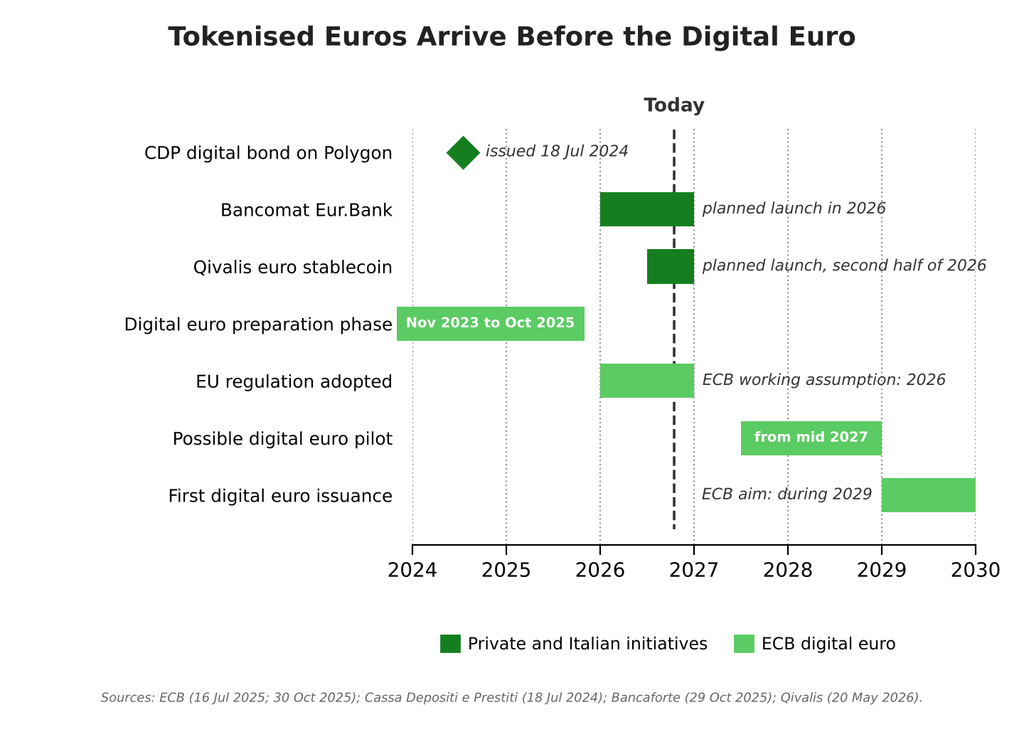
Long before Frankfurt decides whether to issue a digital euro, Italy is already building the plumbing for tokenised money. Bancomat, which runs the country’s domestic debit card scheme, is preparing Eur.Bank, a stablecoin pegged to the euro that Italian banks would issue on Bancomat’s infrastructure; as its chief executive, Fabrizio Burlando, puts it, “we position ourselves as enablers, not as issuers” (Padovan; my trans.). UniCredit and Banca Sella, meanwhile, are among the founders of Qivalis, a consortium that had grown to 37 European banks by May 2026 and plans to launch its own euro stablecoin in the second half of the year (“Qivalis, Joint Venture”; “Qivalis More Than Triples”). The Bank of Italy’s Paolo Angelini cited both projects in an April speech on the state of stablecoins (Angelini).
The groundwork goes back further still: in July 2024, Cassa Depositi e Prestiti issued Italy’s first digital bond on a public blockchain under the Fintech Decree, fully underwritten by Intesa Sanpaolo and settled through the Bank of Italy’s own infrastructure (“CDP Successfully Issues”).
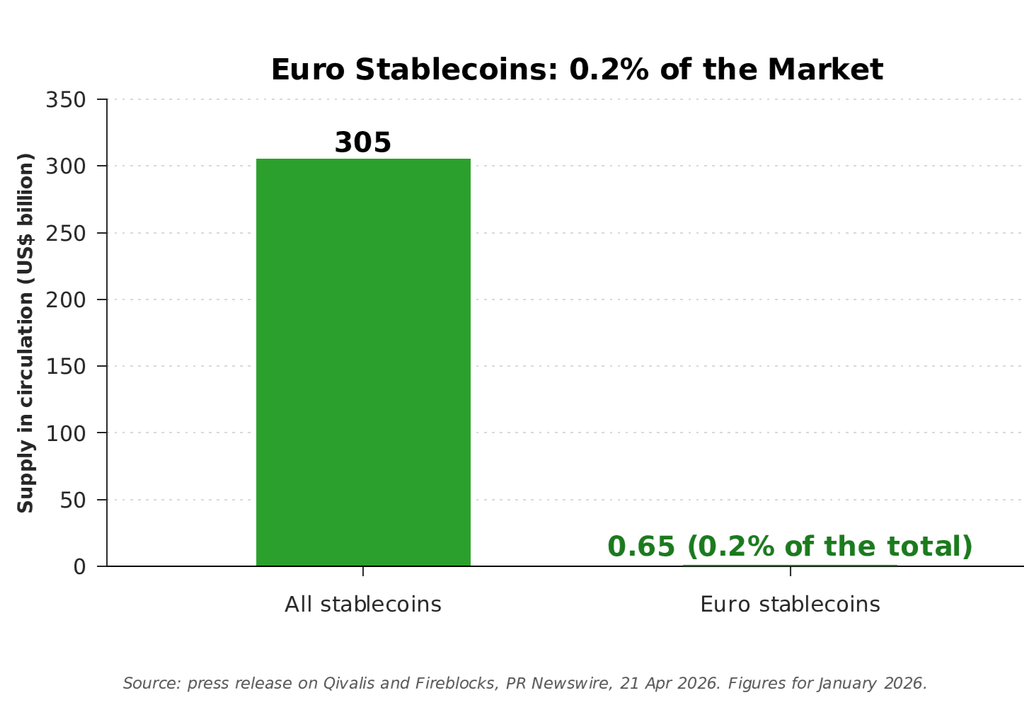
These projects target a market in which euro stablecoins account for only 0.2% of global circulation (“Qivalis More Than Triples”), and they will reach it years before any digital euro; the European Central Bank (ECB) aims to be ready for a potential first issuance only during 2029 (“Preparation Phase”).
The central bank has drawn a line. A footnote to its third progress report, published in July 2025, states that “the digital euro would not be programmable money” (“Progress” n5); yet the same report records around 70 market participants testing conditional payments on its innovation platform (“Progress”).
The tools for attaching rules to money are therefore arriving in Europe whether or not the central bank chooses to use them. The question is no longer whether money can be programmed. It is who programmes it, and what those rules are allowed to restrict. To answer it, we first need to be clear about what “programmable” means.
Programmable Money or Conditional Payments?
Two ideas are often confused in the debate on digital money: programmable money and conditional payments. They sound alike, but they work in different ways. Programmable money restricts what the money itself can be used for, for example by limiting spending to specific goods, services, recipients or periods. A conditional payment only decides when the transfer happens. A payment can be released to a merchant once the product has been delivered, and after that the money is free to go anywhere. Automating a payment is not the same as controlling how people spend.
The digital euro is meant to complement cash as digital central bank money, usable for a broad range of everyday payments. The ECB says it would not introduce programmable money, although it could support conditional payments. Its closing report on the preparation phase, published in October 2025, describes the experiments of those 70 participants, among them banks, fintech companies and merchants. In a simulated environment, they tested payments triggered by set conditions, such as the delivery of a product or the completion of a service. Such uses could make payments more efficient, lower transaction risk and support new business models without limiting what users can buy. In Europe payments can be programmed while money stays fungible and free to use.
But can stablecoins actually become part of the global payment system of the future?
Stablecoins are digital assets designed to hold a stable value against a reference asset, usually a currency such as the US dollar. They run on blockchains and can interact with smart contracts, which opens the way to automated transactions and faster cross-border transfers. According to Paolo Angelini, Director of Banca d’Italia, the stablecoin market reached approximately $315 billion in capitalisation in April 2026, around 13% of the total crypto-asset market. Most of it, however, still circulates inside the crypto ecosystem, and everyday payments in the real economy remain limited.
So the answer is yes, potentially, but not automatically. Stablecoins could become part of future payment infrastructure, especially for international transfers, digital commerce and payments that must settle around the clock across time zones. Smart contracts could also make conditional payments more efficient by releasing funds when a contract is fulfilled. But adoption depends on trust. Users and businesses need to know that a stablecoin keeps its value, can be redeemed reliably and operates under clear regulation. Fragmentation between blockchains, liquidity risk and uncertainty over the protection of holders could limit its use as a universal means of payment. The Bank for International Settlements (BIS) points to the same weak spots: trust, the singleness of money and the integrity of payments. The role of stablecoins will depend on fixing these weaknesses while keeping the advantages of programmability.
The real question now is not just whether money can be programmed, but who gets to decide how it is used. As digital payments evolve, the challenge is to make transactions faster and more efficient without limiting people’s freedom to use their money or undermining trust in the system.
China: The Largest Test
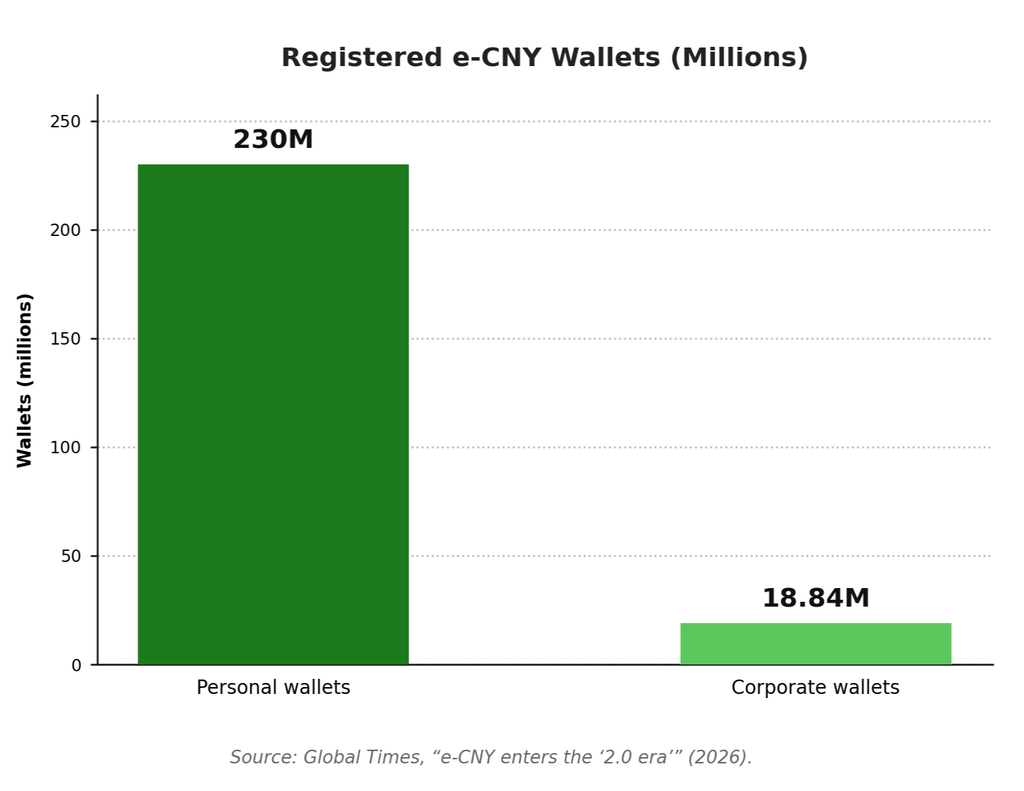
China’s digital yuan (e-CNY) is a central bank digital currency (CBDC) developed by the People’s Bank of China (PBOC), and work on it began in 2014. It runs on two tiers: the central bank issues the currency to authorised operating institutions, which then distribute it to the public. By the end of November 2025, e-CNY transactions had reached 3.48 billion, representing an aggregate monetary turnover of 16.7 trillion yuan. The e-CNY app had opened 230 million personal wallets and 18.84 million corporate ones, according to central bank data reported by the state-run Global Times.
A new phase began on 1 January 2026, the “2.0 era”. The e-CNY now earns interest at demand-deposit rates. According to China Central Television (CCTV), as reported by Global Times, this makes it the world’s first interest-bearing CBDC and moves it from “digital cash” to “digital deposits”.
The e-CNY follows an account-based approach compatible with distributed ledger technology, while incorporating smart-contract programmability. Chinese authorities have often linked decentralised cryptocurrencies and private stablecoins to financial risk. The e-CNY offers programmability too, but under central control. The PBOC’s 2021 white paper said smart contracts allow self-executing payments under preset conditions. In 2022, the PBOC’s Mu Changchun said they could lower costs, and that every model must pass compliance review before use.
One practical application is prepaid-fund management in commercial services. In an example reported in 2022 in Chengdu, parents could prepay after-school classes in e-CNY through a smart contract, and the tuition was refunded automatically when classes were missed. This is a conditional payment in the sense described above: the payment follows the service, and the money stays ordinary money. Other reported uses include government subsidies and retail marketing, and e-CNY payments have also reached public transport and taxation.
China’s 15th Five-Year Plan (2026–2030) provides a broader policy context for the development of the e-CNY. According to Global Times, the plan calls for secure and efficient financial infrastructure and steady development of the digital renminbi, while local initiatives such as those in Shanghai and Yunnan emphasize cross-border payments, and analysts expect the e-CNY to connect the real economy, data assets and global trade. The central question is not whether China can digitize its currency, but whether the e-CNY can achieve large-scale adoption and measurable economic benefits while maintaining the degree of central control that distinguishes it from decentralized digital currencies.
Russia and India: Programmable Money as Social Policy
Russia and India use digital money for public policy, but in different ways. Russia makes acceptance an obligation for banks and large retailers. India tests digital-rupee tokens that can be spent only on a defined welfare entitlement.
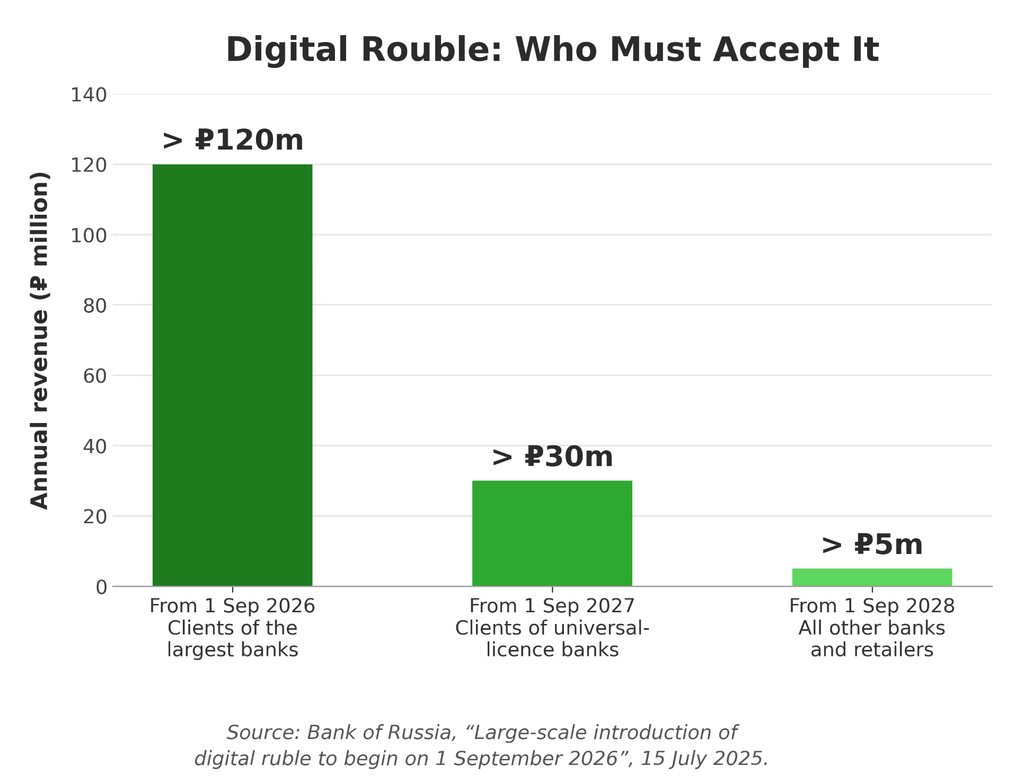
Calling the digital rouble “compulsory” would be misleading. Since 1 September 2026, Russia’s 12 systemically important banks must offer digital-rouble services, and retailers that bank with them and earned more than ₽120 million in the previous year must accept the currency. The obligation applies to banks and certain retailers, not to citizens, who remain free to choose between cash, bank deposits and digital roubles. For individuals, transactions are fee-free.
The digital rouble is a third form of the national currency, next to cash and bank deposits. People hold it in wallets inside their usual banking apps. Since 1 September 2026, Russia’s 12 systemically important banks must offer digital-rouble services. Retailers that bank with them and earned more than ₽120 million last year must accept it. Citizens remain free to choose cash, deposits or digital roubles, and individual transactions are fee-free. The obligation widens in steps. From September 2027 the retailer threshold falls to ₽30 million, and by September 2028 every bank is covered, as is every retailer above ₽5 million (Bank of Russia).
Programmable money is currency that carries rules about who may spend it, on what and when. In Russia, programmability has so far been tested rather than applied to ordinary consumer payments. From March 2025, the Bank of Russia and Tatarstan’s finance ministry trialled conditional spending of earmarked budget funds in a simulated environment. The aim was to see whether public money could be released and monitored under set conditions, with a complete digital record.
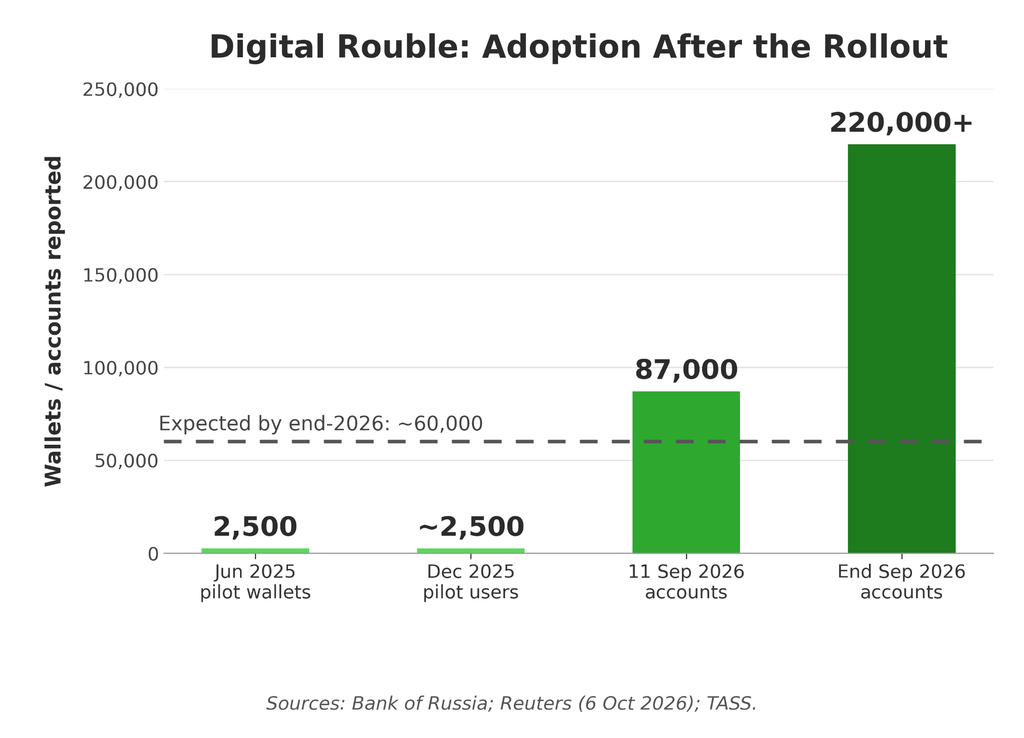
Opening a wallet is not the same as using it. The pilot counted about 2,500 wallets in June 2025. After the launch, the central bank reported 87,000 accounts within ten days and more than 220,000 by the end of September, against an expectation of about 60,000. But the first 87,000 accounts came with only about 50,000 transactions, and the governor said many people were just testing. Even 220,000 is below 0.2% of Russia’s population. Sberbank added that most of its first accounts held minimal balances (Reuters; TASS). A rule can bind banks and shops, but it reaches people only if they hold and use a wallet.
India starts from the recipient, not the shop. On 15 February 2026, the government launched a pilot in Gujarat that delivers food subsidies as programmable digital rupees (e₹). It covers about 26,000 families in four districts, Ahmedabad, Anand, Valsad and Surat, within the Public Distribution System (PDS), which serves more than 80 crore (800 million) people across India.
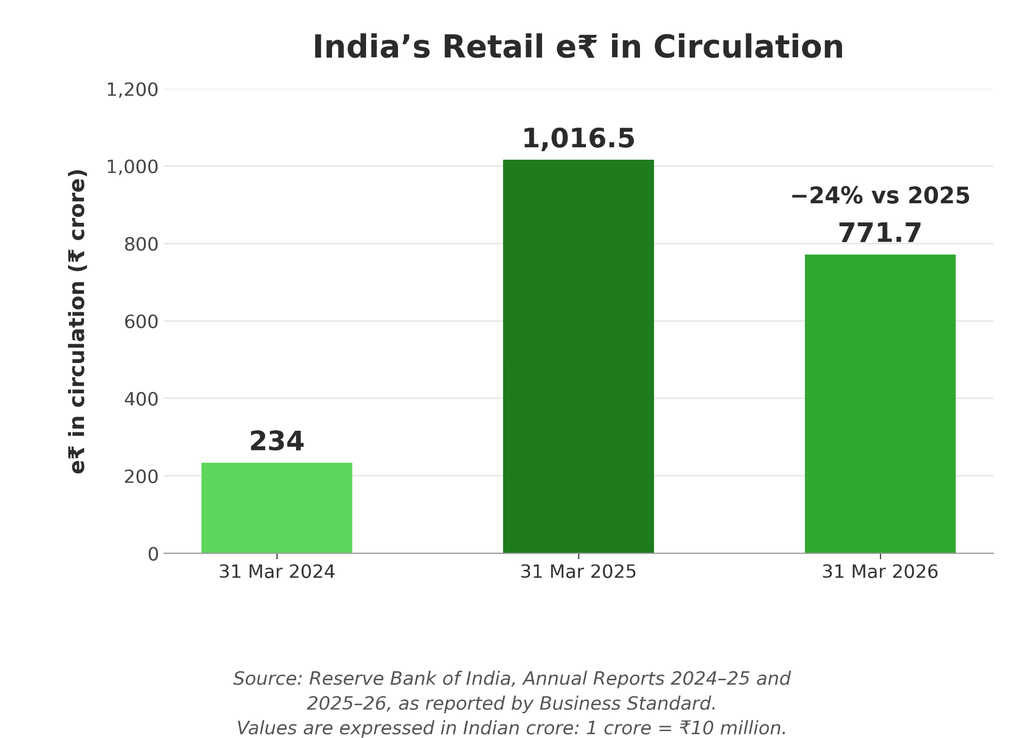
The government says the system improves transparency, reduces leakage and leaves a real-time digital trail. According to the Observer Research Foundation (ORF), each token can be redeemed only for a specific quantity of a specific commodity at an authorised Fair Price Shop. The pilot also includes a grain ATM that dispenses 25 kilograms in 35 seconds. As ORF notes, a food token cannot buy medicine in an emergency. The condition that limits diversion also limits the recipient’s control. The wider digital rupee remains small: retail e₹ in circulation fell 24% in the year to March 2026 (Business Standard).
Russia conditions the infrastructure; India conditions the money. In Russia, banks and merchants must accept the digital rouble, while citizens stay free. In India, the token itself limits what a welfare recipient can buy. Different tools, same question: who decides the conditions attached to digital money?
Back to Europe: Where the Rules Should Live
In a speech titled “Digital Money and the Architecture of Trust”, the Bank of Italy’s Chiara Scotti noted that “money may change form, but it always depends on trust”, and that central bank money “remains the common reference point for settlement, convertibility and singleness” (Scotti).
Programmable money is not new to Italy; it has simply never needed a blockchain. The Carta Dedicata a te, a Poste Italiane prepaid card, will give 1,177,597 households on low incomes €1,000 across 2026 and 2027, for basic food only and never for alcohol (“La Carta”). Meal vouchers work the same way: they buy only food, cannot be cashed or passed on, and no more than eight can be used at once (“Tutto sui buoni pasto”).
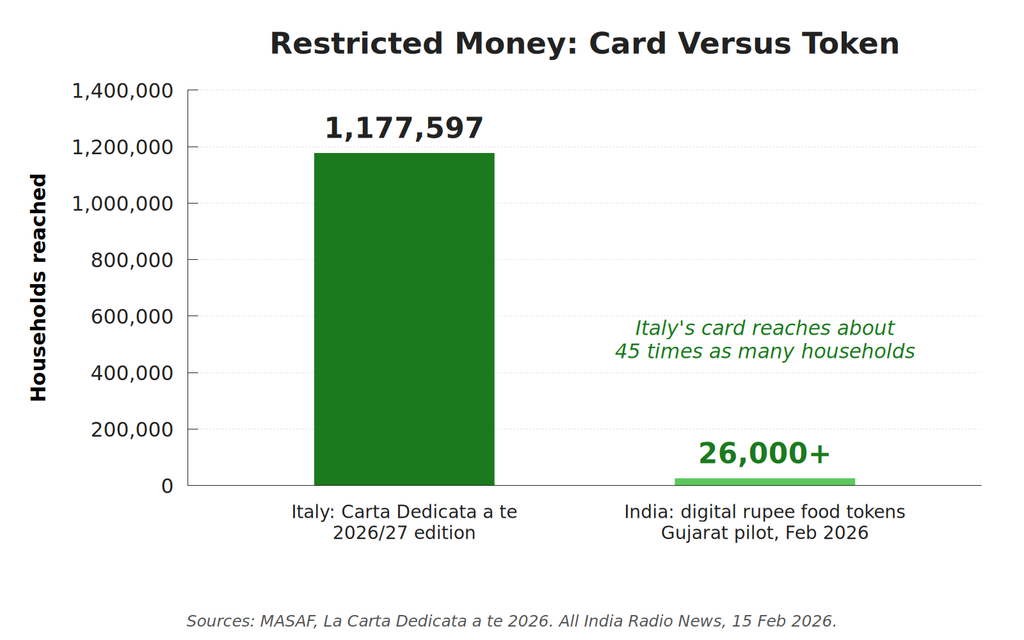
The real question is not whether money can carry conditions but where they live. Today they sit on a card run by a public agency, which can be redesigned or withdrawn while the euro underneath stays an ordinary euro. Moving the restriction into the monetary base itself, as India’s food tokens already do for over 26,000 families (“HM Amit Shah Launches”), would change the nature of money, not just the design of a benefit. The ECB’s footnote is therefore less a technical detail than a constitutional one: it keeps the rules on the card, where governments answer for them, and out of the money.
Written by:
- Melis Boztosun
- Claudia Cristofolini
- Giorgio Signorile
- Matilde Sommese